
Theatre Acoustic Design: A Complete Guide for Performance Spaces
Theatre acoustic design is the process of shaping, isolating, treating and commissioning a theatre so speech, music and stage sound are heard clearly across the audience area. A good theatre is not created by adding panels after construction. It depends on room volume, geometry, early reflections, reverberation time, background noise, sound isolation, mechanical services, seating layout, AV integration and the way acoustic intent is protected through procurement and construction.
For serious theatre, auditorium and performance-space projects, the acoustic result is determined long before the room looks complete. A ceiling angle, balcony depth, door threshold, duct route, wall junction, glazing frame or product substitution can affect the finished performance. That is why AKA Acoustics approaches theatre acoustics as an integrated delivery problem: acoustic strategy, technical design, material selection, specialist supply, construction coordination, AV integration and commissioning all need to be aligned from the start.
Planning a theatre or high-performance acoustic space?
AKA coordinates the acoustic design, specialist products, delivery partners and commissioning pathway before the room is locked into costly decisions.
Contact AKA AcousticsCall 1300 039 639What is theatre acoustic design?
Theatre acoustic design is the coordinated design of the room, envelope, finishes, services and sound system so the audience receives useful sound and is protected from unwanted noise. It includes both room acoustics, which control what happens inside the theatre, and sound isolation, which controls noise transfer into and out of the theatre.
Those two ideas are often confused. Acoustic treatment, such as absorptive panels, diffusers, banners and reflective surfaces, changes how sound behaves inside the room. Sound isolation, sometimes called soundproofing, stops sound moving through walls, floors, ceilings, doors, glazing, structure and services. A theatre can have excellent treatment and still fail if foyer noise, plant noise, traffic rumble or sound from an adjacent tenancy leaks through the envelope.
The design objective is not simply to make the room “quiet” or “not echoey”. A theatre must support the performance. In a drama room, the audience needs intelligible speech and strong early reflections. In a music room, the room needs reverberance, warmth and lateral energy. In a multipurpose venue, the design must move between both conditions without compromising isolation, comfort, sightlines, services or operational flexibility.
Theatre acoustics vs auditorium acoustics
A theatre and an auditorium are related, but they are not always the same acoustic problem. A theatre is usually performance-led, often speech-led, and judged by how clearly the stage communicates to the audience. An auditorium is a broader assembly-space term that may cover lecture halls, school halls, council chambers, recital rooms, multipurpose halls, conference rooms and performance venues.
The practical difference is the acoustic target. A drama theatre usually needs a shorter reverberation time, strong early reflections and a low enough noise floor for unamplified or lightly reinforced speech. A music-led auditorium usually needs more reverberant support, greater spaciousness and room geometry that supports lateral reflections. A lecture theatre prioritises speech intelligibility, coverage and control of mechanical noise. A cinema or post-production theatre places heavier emphasis on isolation, low background noise, loudspeaker integration and controlled decay.
| Space type | Primary acoustic priority | Typical design emphasis |
|---|---|---|
| Drama theatre | Speech intelligibility and stage presence | Shorter reverberation, strong early reflections, low noise floor, clear stage-to-seat coverage |
| Music auditorium | Reverberance, warmth and spaciousness | Longer decay, early lateral reflections, diffusion, appropriate volume per seat |
| Lecture theatre | Clear amplified and unamplified speech | Short reverberation, controlled reflections, good loudspeaker coverage and low services noise |
| Cinema or post-production theatre | Translation, isolation and controlled playback | Low background noise, loudspeaker integration, low-frequency control, isolation and calibrated playback |
| Multipurpose venue | Operational flexibility | Variable acoustics, AV flexibility, robust finishes and clear operating modes |
This is why a generic auditorium treatment package rarely solves a theatre properly. The room needs a performance brief before it needs a product list.

What makes a theatre acoustically good?
A good theatre gives the audience a clear relationship to the stage. Speech should arrive with intelligibility and presence. Music should have appropriate support and warmth. Background noise should be low enough that quiet moments remain audible. Reflections should strengthen the performance rather than blur it. The sound should feel even across the audience area, not excellent in a few centre seats and compromised under balconies, near walls or at the rear.
Four technical elements usually decide whether the room works:
- Room geometry. The room shape, ceiling, side walls, rear wall, balcony, rake and stage opening determine where useful sound goes and when reflections arrive.
- Reverberation and clarity. The room needs a decay time suited to its volume and use. Too long and speech blurs. Too short and the room feels dry, weak and unsupportive.
- Sound isolation and background noise. Foyer noise, traffic, adjacent spaces, plant noise and air-conditioning noise must be controlled so the performance is not masked.
- Delivery quality. Acoustic intent must survive product selection, procurement, substitution, site detailing, service penetrations, door installation, AV coordination and commissioning.
In high-performance rooms, acoustic design cannot be separated from architecture, structure, services, AV, operation and construction. The issue is rarely one product. It is the system, the junctions, the installation and the verification.
The key acoustic parameters in a theatre
A theatre should be designed and assessed using measurable acoustic criteria. The exact values depend on the brief, volume, occupancy, stage use, amplification strategy and required standard. The table below gives the practical parameters that usually matter.
| Parameter | What it tells you | Why it matters |
|---|---|---|
| Reverberation time, usually T20 or T30 | How long sound takes to decay in the room | Controls perceived liveliness, speech blur and musical support |
| Early Decay Time, or EDT | The early part of the decay that listeners often perceive most strongly | Helps describe how live or immediate the room feels |
| C50 | The ratio of early sound energy within 50 milliseconds to later sound energy | A core speech clarity measure for theatres and lecture spaces |
| C80 | The ratio of early sound energy within 80 milliseconds to later sound energy | More relevant to music clarity than speech clarity |
| STI, or Speech Transmission Index | Objective speech intelligibility on a scale from 0 to 1 | Useful for speech-led theatres, lecture rooms, public address and emergency communication |
| Sound strength, or G | How much acoustic support the room gives to a source | Helps describe whether rear seats feel supported or distant |
| Background noise level | Noise from HVAC, plant, foyer, traffic, lighting systems and adjacent spaces | Determines whether quiet passages and soft speech can be heard |
| Airborne and impact isolation | How much sound is blocked between the theatre and neighbouring spaces | Protects the theatre from external noise and protects neighbours from theatre noise |
For performance spaces, ISO 3382-1 is commonly used for room-acoustic measurements such as reverberation time, EDT, clarity and strength. IEC 60268-16 is relevant where Speech Transmission Index is assessed. For airborne and impact isolation, standards such as ISO 16283 and ISO 717 are relevant depending on the measurement scope. AS/NZS 2107 is commonly referenced in Australia and New Zealand for recommended internal noise levels and reverberation guidance across different occupancy types.
What reverberation time should a theatre have?
There is no single correct reverberation time for every theatre. The target depends on room volume, use, occupancy, stage type, seating, finishes, audience absorption and whether the room is speech-led, music-led or multipurpose.
As a practical guide, speech-led theatres and lecture spaces usually need shorter mid-frequency reverberation times than music-led performance halls. Drama theatres often sit around the lower end of the performance-space range, while recital, orchestral and music-led auditoria need longer decay and stronger lateral energy. A multipurpose theatre may need variable acoustics so the room can change between a clearer speech setting and a more reverberant music setting.
Reverberation time is governed by the relationship between room volume and absorption. A larger room generally needs more acoustic volume and can tolerate a longer decay. A smaller speech room usually needs a shorter decay. The audience also matters: people and upholstered seating absorb sound, so an empty theatre can behave differently from an occupied theatre unless the seating is selected and modelled carefully.
| Use case | Reverberation tendency | Design note |
|---|---|---|
| Drama and speech-led theatre | Shorter, clearer decay | Protects speech intelligibility and reduces late-energy masking |
| Lecture theatre or council chamber | Short and controlled | Supports speech, amplified presentation and public address |
| Music-led auditorium | Longer and more supportive | Requires appropriate room volume, lateral energy, diffusion and stage support |
| Cinema or post-production theatre | Controlled and even | Must support loudspeaker playback, bass control and translation |
| Multipurpose venue | Variable | May need banners, curtains, rotating panels, coupled volume or electronic enhancement |
The target should be set during concept design, not after the architectural form is fixed. Once the volume, ceiling profile, balcony depth and surface geometry are built, later treatment can adjust the room but may not fully correct the underlying acoustic shape.
Why early reflections matter in theatre design
The audience does not hear only the direct sound from the stage. It also hears reflections from the ceiling, proscenium, side walls, balcony faces, rear wall, floor, seating and architectural surfaces. Some reflections help. Others damage clarity.
For speech, reflections arriving within roughly the first 50 milliseconds can reinforce the direct sound and improve clarity. Reflections arriving later can blur consonants, reduce intelligibility or become audible echoes. That is why C50, the ratio of early sound energy to late sound energy, is a useful speech-clarity parameter.
In a theatre, the design problem is therefore not simply “more absorption”. The room needs the right reflections in the right places at the right time. Over-absorbing the ceiling and side walls may shorten reverberation, but it can also remove the early energy that carries speech to the rear seats. Leaving the room too reflective may create slap echo, flutter echo or late-energy build-up. The design must shape, preserve, absorb or diffuse surfaces according to function.
Stage, seating and audience acoustics
Theatre acoustics are affected by the stage, the audience chamber and the relationship between them. A performer needs acoustic support from the stage environment. The audience needs direct sound and useful early reflections. The seating rake must protect both sightlines and sound paths. The balcony, if present, must not starve seats below it of acoustic energy.
Seating rake is an acoustic issue, not only an architectural or sightline issue. Sound travelling at a shallow angle across rows of seats can lose energy, particularly through the low-mid frequency range. A well-designed rake helps preserve the direct sound path and supports consistent coverage from front to rear.
Side walls are also critical. In a speech-led room, they can provide useful early reflections that strengthen the voice. In a music-led room, early lateral reflections help create width and spaciousness. In an over-wide fan-shaped room, side-wall reflections may arrive too weakly or too late, leaving the room less intimate and less supportive.

Sound isolation: foyer, street, plant and adjacent spaces
Sound isolation is separate from room acoustic treatment. A theatre needs to keep external noise out and, where relevant, keep performance noise from disturbing neighbouring spaces. This is usually achieved with mass, separation, sealing, resilient construction, isolated services and carefully detailed junctions.
The weakest path sets the result. A high-performing wall can be undermined by a door seal, glazing frame, threshold, duct penetration, cable pathway, shared ceiling plenum, rigid fixing, structural bridge or poorly coordinated services route. Laboratory ratings such as Rw or STC are useful, but they do not guarantee field performance. The built result depends on the full system and how it is installed.
For demanding theatres, cinemas, studios and post-production rooms, isolation may require mass-air-mass construction, acoustic doors, acoustic glazing, resilient mounts, floating floors, isolated ceilings, duct silencers, low-velocity air distribution and plant vibration isolation. Where the theatre is near residential spaces, hotel rooms, sensitive tenancies, rail corridors, roads or high-noise entertainment uses, the isolation design should be resolved early and verified by measurement where the project requires it.
Background noise and mechanical services
Many theatre acoustic failures are not caused by the room treatment. They are caused by mechanical services. Air-conditioning noise, grille noise, duct breakout, fan noise, pumps, switchrooms, hydraulic systems, lift equipment, lighting dimmers and building services can raise the background noise floor until quiet passages are masked.
Low background noise is not achieved by asking the mechanical contractor to “keep it quiet” at the end of the job. It requires coordinated design: low air velocities, appropriate duct sizing, silencers, lined ductwork where suitable, vibration isolation, plant-room separation, flexible connections, careful grille selection and space allowance for acoustic control. The quieter the target, the earlier the services strategy needs to be locked in.
This is one reason integrated delivery matters. If the acoustic design, mechanical design, AV requirements and architectural ceiling zone are handled separately, the quietest part of the performance may end up depending on a late-stage duct route or a grille substitution. For a theatre, that is not a minor coordination issue. It can define the room.
Can one theatre work for drama, speech, music and events?
One theatre can support multiple uses, but usually not by using one fixed acoustic condition. Speech, drama, amplified events, chamber music, orchestral use, cinema playback and conferences can demand different reverberation, clarity, coverage and noise-control requirements. A multipurpose room needs an acoustic strategy, not a compromise disguised as flexibility.
Variable acoustics can help a room move between operating modes. The simplest approaches use retractable banners, curtains or absorptive elements. More developed systems use rotating panels, adjustable reflectors, demountable orchestra shells, coupled reverberation chambers or electroacoustic enhancement systems. The right approach depends on the performance range the venue genuinely needs.
| Variable acoustic element | What it changes | Typical use |
|---|---|---|
| Retractable banners or curtains | Adds or removes absorption | Speech, conferences, amplified events and multipurpose halls |
| Rotating or hinged acoustic panels | Changes surfaces between reflective, absorptive or diffusive conditions | Flexible theatre and music spaces where finish integration matters |
| Orchestra shell | Improves projection and on-stage support for musicians | School halls, theatres and auditoria used for music performance |
| Coupled volume | Opens or closes additional reverberant volume | Higher-end venues needing a wider acoustic range |
| Electronic acoustic enhancement | Uses microphones, processing and loudspeakers to alter perceived acoustic response | Venues requiring multiple recalled acoustic modes |
Variable acoustics should be modelled, detailed and commissioned as part of the theatre, not added as a cosmetic feature. The operating modes must be simple enough for the venue team to use correctly, otherwise the room will default to one compromised setting.
What should be specified in a theatre acoustic brief?
A strong theatre acoustic brief defines the outcome, not just the treatment package. It should give the design team, builder, services team, AV team and procurement team enough information to protect acoustic performance through the project.
| Brief item | What to define | Why it matters |
|---|---|---|
| Primary uses | Drama, music, lectures, cinema, amplified events, worship, rehearsal or multipurpose use | The room cannot be tuned properly without knowing the real operating modes |
| Room-acoustic targets | Reverberation, clarity, speech intelligibility, strength and frequency balance where relevant | Sets the measurable performance basis for design and commissioning |
| Isolation criteria | Noise ingress, noise egress, adjacent uses, doors, glazing, structure and services paths | Prevents isolation being reduced to a wall rating while weak paths remain unresolved |
| Background-noise target | Internal noise level from HVAC, plant, lighting, equipment and adjacent spaces | Protects quiet passages and prevents services from defining the room |
| AV and electroacoustic requirements | Loudspeaker strategy, coverage, control, cinema or immersive requirements, assistive listening and calibration | The sound system and room response must be designed together |
| Architectural integration | Finish intent, heritage constraints, seating, lighting, ceiling zones, sightlines and maintainability | Acoustic systems must work visually, technically and operationally |
| Verification method | What will be measured, when it will be measured and what acceptance criteria apply | The room is not finished when it looks complete. It is finished when it performs. |
Consultant-only, builder-led or integrated delivery?
Theatre acoustics are affected by many parties: acoustic consultants, architects, structural engineers, mechanical engineers, builders, joiners, plasterboard contractors, door suppliers, glazing suppliers, AV integrators, lighting designers, seating suppliers, project managers and venue operators. If each party works in isolation, acoustic performance can be diluted through RFIs, substitutions, unclear interfaces and late-stage site decisions.
The right model depends on the project, but the delivery structure should be chosen deliberately. A high-performance theatre needs someone to protect the acoustic intent from concept through to commissioning.
| Project model | Typical strength | Common risk | Where AKA adds value |
|---|---|---|---|
| Separate acoustic consultant | Independent advice, modelling and reporting | Design intent can be diluted during procurement, substitution or installation | AKA carries acoustic intent through specification, supply, coordination, construction support and commissioning |
| Builder-led delivery | Programme control and construction execution | Acoustic systems may be treated like standard partitions, finishes or fit-out items | AKA protects performance at junctions, penetrations, interfaces, tolerances and handover |
| Product supplier only | Material availability and logistics | A product may be selected without the right build-up, installation method or verification process | AKA connects product selection to acoustic intent, buildability and project-specific performance requirements |
| AV integrator only | Technology deployment, wiring, system setup and tuning | The room, isolation, background noise and geometry may limit the final result | AKA coordinates the acoustic room, AV system, loudspeaker strategy, finishes and commissioning process together |
| AKA integrated delivery model | Engineering, design, product selection, delivery coordination and commissioning aligned from the start | Requires early engagement and a clear performance brief | One streamlined pathway from technical intent to completed performance environment |
Need acoustic design, supply and delivery under one coordinated pathway?
Speak with AKA before the project is split across consultants, suppliers and trades with no single party protecting the final performance.
Contact AKA AcousticsCall 1300 039 639Common theatre acoustic failures
Most theatre acoustic failures are predictable. They usually happen when geometry, isolation, services, finishes and commissioning are not considered together.
- Late echo from rear walls or balcony faces. Hard rear surfaces, concave shapes and balcony fronts can send delayed reflections back into the room.
- Flutter echo between parallel surfaces. Hard, parallel walls or ceilings can create rapid repeating reflections that make speech sound brittle or buzzy.
- Dead seats under balconies. Deep overhangs can block useful early and reverberant energy, leaving seats below dull and disconnected.
- Over-absorption. Too much absorptive treatment can reduce reverberation but also remove useful support, making the room dry and weak.
- Uncontrolled low frequency. Large surfaces, room volume, seating, stage cavities and subwoofer systems can create uneven bass response or structure-borne noise.
- HVAC noise. Mechanical systems can raise the background noise floor and mask quiet passages.
- Door, glazing and penetration leaks. A high-performing wall is undermined if doors, frames, thresholds, cable penetrations and ductwork are not detailed properly.
- Product substitution. Replacing specified acoustic systems with visually similar but technically different products can change absorption, fire rating, durability, isolation or installation performance.
- AV added after the room is finished. Loudspeakers, screens, projection, control systems and assistive listening need to be coordinated with the room, not imposed on it later.
- No commissioning measurement. Without measurement, the project may rely on assumptions rather than a verified result.
The earlier acoustic intent is defined, the less expensive it is to protect. Once the room is built, acoustic fixes become more visible, more disruptive and less certain.
How AKA Acoustics approaches theatre acoustic design
AKA Acoustics works as a turnkey acoustic delivery partner for theatre, auditorium, cinema, studio and high-performance venue projects. The role is not limited to writing recommendations. AKA coordinates the pathway from acoustic brief to finished performance environment.
That pathway may include acoustic briefing, room-acoustic strategy, sound-isolation design, vibration advice, mechanical-noise coordination, product selection, specialist material sourcing, construction detailing, supplier coordination, installer input, AV and electroacoustic integration, site review, commissioning measurement and handover documentation.
This integrated approach is important because theatre performance is affected by many interfaces. The acoustic wall is affected by the door. The room response is affected by the ceiling geometry. The background noise is affected by the mechanical system. The audience experience is affected by AV coverage and seating. The final result is affected by what is actually procured and installed. AKA’s role is to close the gap between design intent and site reality.
For project teams, that means acoustic performance is not left as a late-stage compliance issue. It is carried through the design, supply and delivery process so architects, builders, services consultants, AV teams and venue operators are working to the same performance outcome.
How theatre acoustics are tested and proven
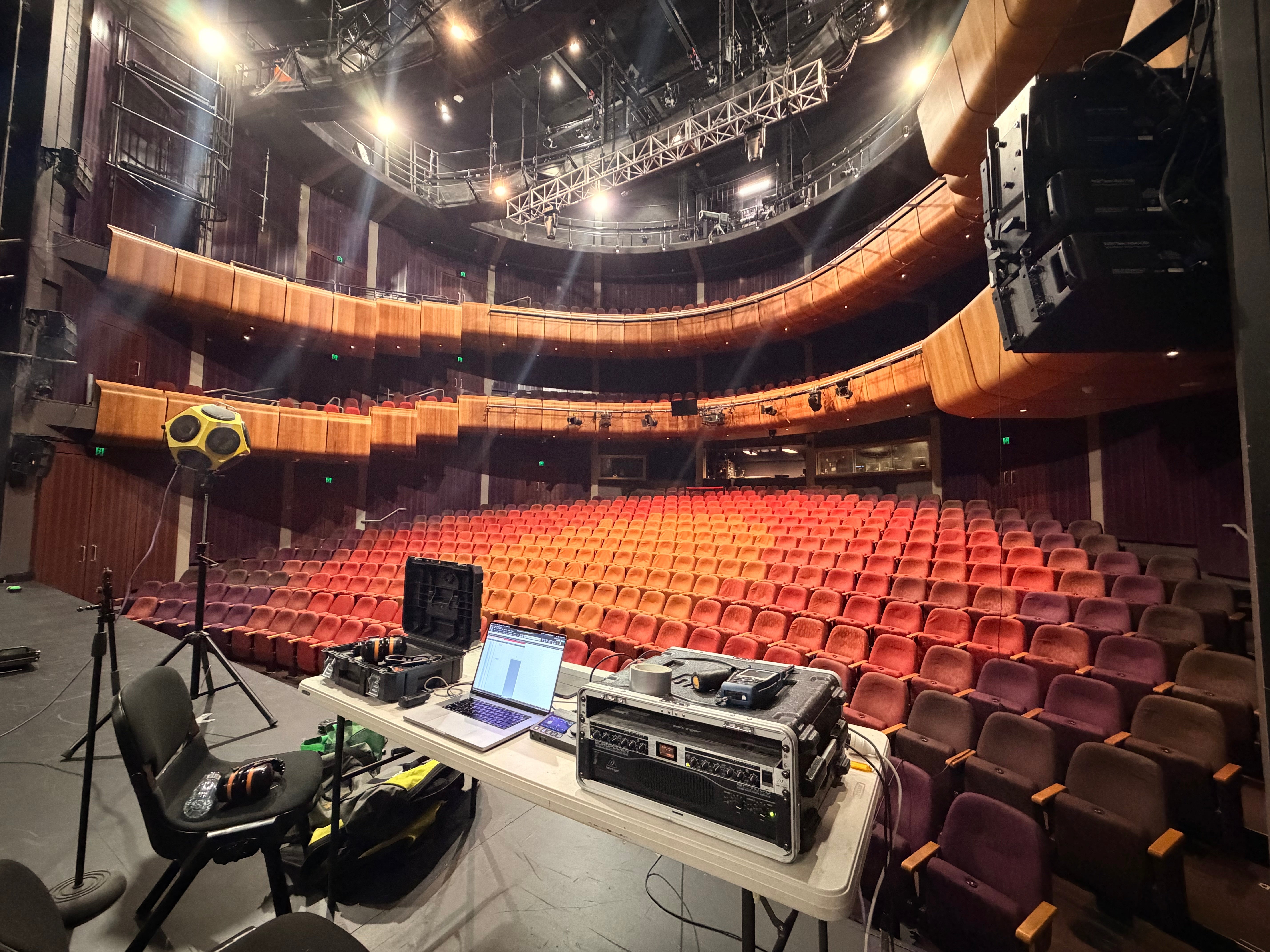
A theatre should be verified by measurement where the project brief requires a defined acoustic outcome. The exact measurement scope depends on the room and the performance criteria, but common tests include room impulse response measurement, reverberation time, clarity, speech intelligibility, background noise and sound isolation.
Room-acoustic testing typically measures the response from source positions to multiple audience positions. This is important because one seat does not represent the whole theatre. A proper assessment looks at spatial consistency, frequency balance and whether the room performs across the seating plane.
Background-noise testing should be undertaken with relevant services operating in realistic modes. Isolation testing, where required, should consider airborne paths, impact paths and flanking transmission. For theatres with AV or cinema functions, commissioning should also include loudspeaker coverage, system tuning, delay alignment, low-frequency behaviour and operational presets.
The point of commissioning is not to create a report after the fact. It is to confirm whether the room meets the design intent and to give the project team a defensible record of the finished performance.
What does theatre acoustic design cost in Australia?
The cost of theatre acoustic design in Australia depends on the performance target, project stage, room volume, existing site conditions, isolation requirement, services noise, vibration risk, finish expectations, AV integration, documentation scope and whether AKA is engaged for advisory work, product supply, delivery coordination, commissioning or a full turnkey pathway.
For high-performance theatres, the cost is driven less by a simple square-metre rate and more by the level of acoustic responsibility the project requires. A speech-led refurbishment, a new multipurpose performance venue, a cinema-grade theatre, a school auditorium and a heritage performance space may each require different levels of modelling, construction detailing, specialist product selection, services coordination, AV integration and verification.
For serious projects, the more useful question is not “what is the cheapest acoustic report?” but “what level of acoustic responsibility does the project need?” A limited review may identify risks, but it will not necessarily carry the design intent through specification, procurement, installation, commissioning and measurement. The more fragmented the procurement model, the more important it is to define responsibilities, performance criteria and verification early.
| Scope element | What it may include | Why it affects cost |
|---|---|---|
| Early acoustic strategy | Brief review, acoustic targets, risk identification, room-use priorities and coordination advice | Sets the performance pathway before the room volume, geometry, services and procurement model are locked in |
| Room acoustic design | Reverberation targets, reflection strategy, clarity, speech intelligibility, audience coverage, variable acoustics and finish integration | More complex rooms require more detailed modelling, coordination and acoustic control across multiple operating modes |
| Sound isolation and vibration control | Walls, floors, ceilings, doors, glazing, flanking paths, structure-borne noise, plant vibration and service penetrations | Isolation cost is usually driven by the required performance, weakest paths, existing structure and tolerance for noise transfer |
| Mechanical services and background noise | HVAC noise control, duct routes, silencers, grille selection, plant isolation and services coordination | Quiet theatres often require early services coordination because noisy air-conditioning is difficult to correct after completion |
| Documentation and specification | Build-ups, junctions, product requirements, tolerances, substitution controls, installation notes and verification criteria | A good specification reduces ambiguity, RFIs, substitution risk and the chance of acoustic intent being lost during construction |
| Integrated design, supply and delivery coordination | Specialist product selection, supplier coordination, construction interfaces, installer input, AV coordination and site-phase support | The more parties involved, the more valuable it is to have one pathway protecting acoustic intent through procurement and delivery |
| Commissioning and verification | Measurement of reverberation, clarity, background noise, isolation, system performance or agreed acoustic criteria | The room is not finished when it looks complete. It is finished when the agreed performance has been checked and documented |
AKA scopes theatre acoustic work after understanding the brief, risk profile, site constraints, procurement pathway and required level of accountability. For major studios, theatres, auditoria, hospitality venues and specialist performance spaces, the commercial question is not the cheapest report fee. It is the cost of getting the room wrong.
Need a scoped acoustic pathway, not a guess?
AKA prices projects after understanding the performance target, site constraints, product requirements, delivery model and level of accountability required.
Contact AKA AcousticsCall 1300 039 639Who designs and delivers theatre acoustics in Australia?
Theatre acoustics in Australia may be handled by acoustic consultants, theatre consultants, AV consultants, builders, specialist contractors, product suppliers or integrated design-and-delivery teams. Each model has a place, but the more performance-critical the room is, the more important it becomes to define who owns the acoustic outcome through construction and commissioning.
AKA Acoustics sits between the traditional categories. The business is not only an acoustic consultant, not only a contractor and not only a product supplier. AKA designs, specifies, sources and coordinates high-performance acoustic, vibration and AV outcomes for serious spaces, with the delivery pathway carried from brief to measured result.
For theatres, auditoria, cinemas, studios and performance spaces, that integrated role reduces the handover gaps common in fragmented project models. It gives architects, builders, owners and operators one technically informed pathway for the parts of the project where acoustic performance, buildability and finish quality need to align.
Frequently asked questions
What is theatre acoustic design?
Theatre acoustic design is the coordinated design of room geometry, finishes, isolation, background noise, services, seating, stage conditions and AV integration so the audience can hear the performance clearly. It includes both room acoustics, which control sound inside the theatre, and sound isolation, which controls noise transfer into and out of the theatre.
What is the difference between acoustic treatment and sound isolation?
Acoustic treatment changes how sound behaves inside a room. It includes absorption, diffusion, reflection control and variable acoustic elements. Sound isolation stops sound moving between spaces through walls, floors, ceilings, doors, glazing, structure and services. Acoustic panels can reduce reverberation, but they do not soundproof a theatre.
What reverberation time should a theatre have?
There is no single correct reverberation time for every theatre. Speech-led theatres usually require shorter, clearer decay than music-led auditoria. The target depends on room volume, occupancy, seating, surface finishes, use case and whether the space needs variable acoustics. The target should be set during concept design and verified during commissioning where required.
Why is speech intelligibility important in theatre acoustics?
Speech intelligibility determines whether the audience can understand dialogue without effort. It depends on direct sound, useful early reflections, controlled reverberation, low background noise and even coverage across the seating area. Parameters such as C50 and STI are often used to assess speech clarity and intelligibility.
Can one theatre work for both drama and music?
Yes, but usually through variable acoustics rather than one fixed condition. Drama and speech often need shorter reverberation and higher clarity, while music often needs more reverberant support and lateral energy. Variable banners, curtains, adjustable panels, orchestra shells, coupled volumes or electronic acoustic enhancement can help a room shift between modes.
Why do theatre acoustic problems often appear after construction?
Many problems are hidden until the room is built and used. Common causes include late product substitutions, poor door seals, noisy HVAC, unresolved flanking paths, excessive balcony depth, reflective rear walls, weak early reflections, AV added after the room is finished and lack of commissioning measurement.
What standards apply to theatre acoustic design in Australia?
Relevant standards may include AS/NZS 2107 for recommended internal noise levels and reverberation guidance, ISO 3382-1 for room-acoustic measurements in performance spaces, IEC 60268-16 for Speech Transmission Index, and ISO 16283 and ISO 717 for building acoustic measurements. The exact standards depend on the project type, building class, approval pathway and agreed performance criteria.
How much does theatre acoustic design cost?
Cost depends on the size, complexity and scope. A diagnostic review or half-day acoustic audit may sit around $1,500 to $4,000 ex GST depending on scope. Full theatre design, documentation, modelling, specialist product supply, construction coordination and commissioning are scoped to the project brief.
Do I need an acoustic consultant or a turnkey acoustic delivery partner?
A consultant-only model may suit projects that need independent advice or reporting. A turnkey acoustic delivery partner is better suited where acoustic performance needs to be protected through design, procurement, specialist product selection, construction interfaces, AV integration and commissioning. For high-performance theatres, the risk is often not the advice alone, but whether the advice survives delivery.
When should AKA Acoustics be involved?
AKA should be involved before the room volume, geometry, ceiling zones, services strategy, isolation approach, AV brief and procurement model are locked in. Early engagement gives the project team more control over performance, cost, buildability and design integration.
Discuss a theatre, auditorium or performance-space project with AKA Acoustics.
For projects where acoustic performance, architecture, services, AV and construction need to align, engage AKA early so the technical pathway is protected from brief to measured result.
Contact AKA AcousticsCall 1300 039 639
Share:
Place of Worship Acoustic Design: Churches, Prayer Halls and Sanctuaries