Ceiling Attenuation Class describes a laboratory assembly the Australian commercial interior does not occupy. AKA Acoustics' paper at INTER-NOISE 2026 argues the integer cannot close a speech-privacy brief.
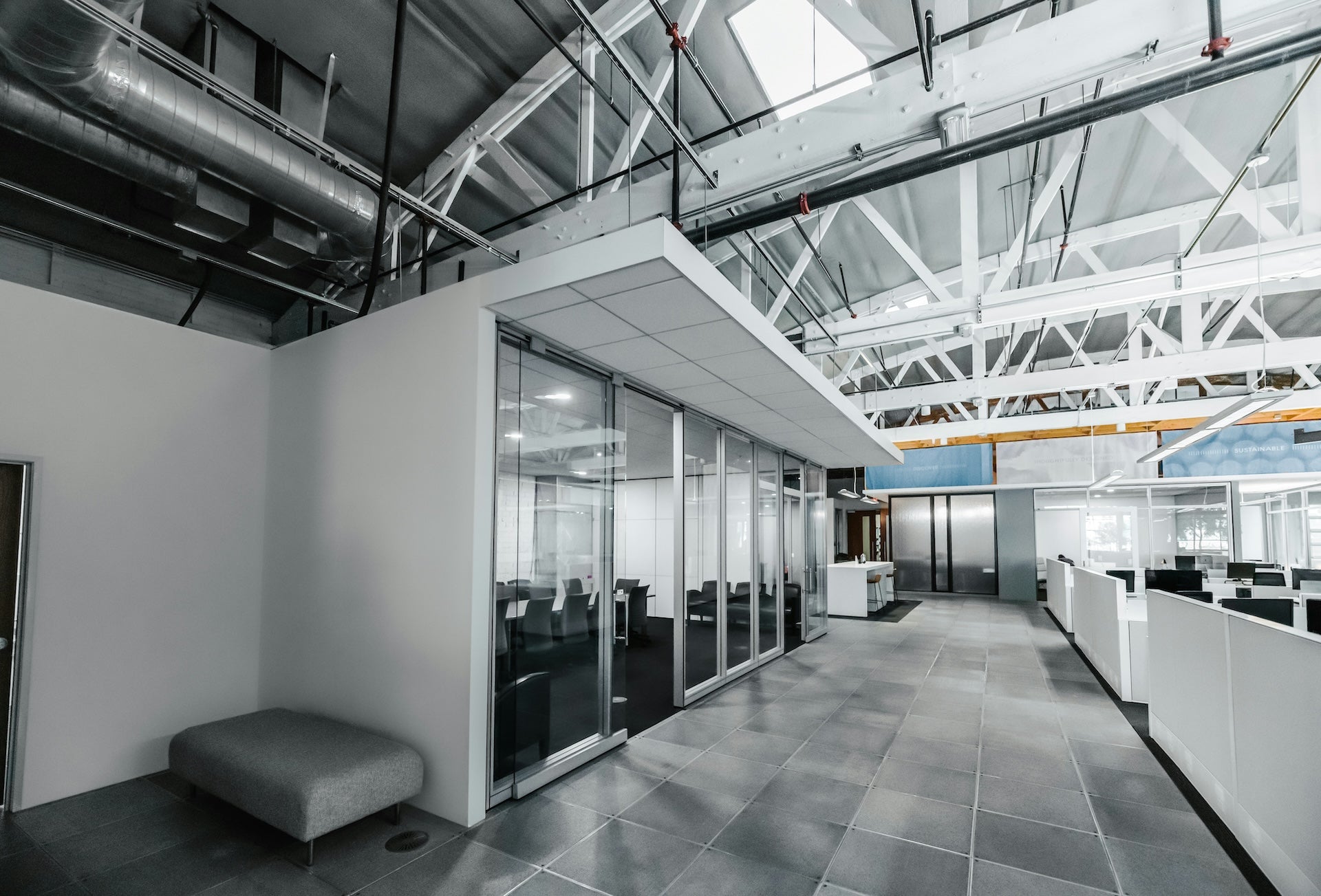
The suspended ceiling is still bought, in most Australian commercial work, as if it were a product with a single acoustic identity. That identity is Ceiling Attenuation Class: an ASTM laboratory rating, compact enough to sit in a schedule beside a colour and a module size, and routinely asked to stand in for speech privacy between rooms. The rooms in question are not the rooms of the test. Their partitions stop at the grid. Their plenums carry ductwork, cable tray, sprinkler mains. The tile on the far side of the wall is often a different product, a different thickness, or, in a great deal of the country's logistics and light-industrial fabric, absent altogether.
That mismatch is why the practice took paper 683 to INTER-NOISE 2026, the 55th International Congress on Noise Control Engineering, held from 9 to 12 August at the Adelaide Convention Centre (INTER-NOISE 2026). The paper, Beyond CAC: A Component-Based Specification Framework for Asymmetric Suspended-Ceiling Fit-outs, by Richard Latimer and Daniel Natoli, is in the Book of Abstracts at page 152 (Book of Abstracts). Its claim is a design-envelope claim. CAC is not merely optimistic in the field. It is defined for an assembly most of the interiors on an Australian drawing set do not resemble.
A test written for symmetry
Ceiling Attenuation Class is measured to ASTM E1414. The method is written for a narrow set of conditions: the same ceiling both sides of the partition, identical tiles, a bounded plenum of controlled depth, no services running through it. The standard's own scope is unusually candid. The measurements, it says, are not a fundamental property of the ceiling. They are a property of that assembly, in that laboratory, under that version of the method.
Most commercial fit-outs depart from the assembly on at least one axis, and often on three.
Services go through the plenum. Published evidence cited in the paper puts the effect of service-element loading at around ten CAC points wideband, with fifteen to twenty-two decibels of the loss landing between 1 kHz and 4 kHz - the band in which speech is intelligible. A ceiling can hold its integer and shed the frequencies for which it was specified.
The neighbour's side is a different tile, or none. Office-in-warehouse shells - a fitted office against exposed structure - are ordinary in Australian industrial work, not a curiosity. CAC has no method for that geometry. To write the integer into that specification is to apply a test to a room it cannot see.
The paper's worked example makes the mixed-tile case concrete. A 19 mm mineral-fibre source ceiling (Rw around 22 dB) facing a 12 mm receiver ceiling (Rw around 16 dB) over a 0.6 m lined plenum predicts an apparent ceiling sound insulation of 37 ± 2 dB. That figure sits between the two symmetric CAC values, 40 and 36. It cannot be read off either datasheet. The rooms architects issue are, more often than the laboratory would like, this kind of room: two different lids on one cavity.
CAC remains useful. It is a screening floor, as mass per square metre is a screening floor: a way of discarding products that cannot possibly work. It is not a number on which to close a speech-privacy brief.

Where the code is silent
The Australian documents that might have caught this do not. Part F7 of the National Construction Code addresses Class 2, 3 and 9c. It has no acoustic provision for Class 5 offices, Class 6 retail, Class 8 laboratories, Class 9a hospitals or Class 9b schools - which is to say, for most of the building types in which a suspended ceiling is asked to do acoustic work. AS/NZS 2107:2016 sets design outcomes for interior noise and reverberation, and specifies no test method for a partition or a ceiling. A search of NATA scope found no Australian commercial laboratory with active accredited scope for ASTM E1414 or ISO 10848-2.
The integer on the Australian datasheet was therefore measured somewhere else, in a geometry the fit-out does not occupy, for a building class the code does not regulate, with nowhere in this country to verify it.
In an audit of eight major ceiling-tile datasheets, none disclosed the plenum depth at which the rating was obtained, none named the laboratory, and none gave the version year of ASTM E1414. The number is published as if it were a property of the tile. On a floor where speech privacy is a stated requirement, the consequence of that omission is not academic. It arrives after handover, in the tenant's words.
The move walls already made
Walls left this problem behind a generation ago. The laboratory rating (STC, Rw) became a field rating (ASTC, DnT,w), and the designer who needed to predict before the wall was built learned to work with component data and a path-by-path method. The same move is available for ceilings. The paper calls the result Apparent Ceiling Sound Insulation: ISO 10140-2 transmission loss, ISO 354 absorption, ISO 10848-2 lateral attenuation, assembled through ISO 12354-1. The name matters less than the ingredients. The ingredients already exist.
Predictions under that method carry about five decibels of single-number uncertainty, per EN ISO 12354-1 Annex K, until a given configuration is validated, and the method is weakest in the mass-air-mass region between 100 Hz and 400 Hz. That is an honest limitation, and it belongs in the design, not in a footnote after the integer has been treated as exact.
What a ceiling datasheet ought to carry, and what European-format sheets already often do, is a small, unglamorous pack: one-third-octave R(f) and Rw, octave-band absorption, Dn,f,w with the plenum depth and grid used in the test, the version year of the method, the laboratory and its ILAC-MRA recognition, and a note on how service penetrations were treated. This is disclosure of a kind those sheets already make.
Field verification is in-situ DnT,w, or ASTC. Where the brief is privacy that has to be certified, Speech Privacy Class under ASTM E2638. Where a supplier answers the question of the installed system with another CAC integer, the rooms themselves are the remaining instrument.
A specification that intends to close speech privacy should be able to answer, of any tile it names, four things. At what plenum depth, and on which grid, was the CAC measured. Which laboratory measured it, and which ILAC-MRA body recognises that laboratory. Which version year of ASTM E1414 was used. And what DnT,w the system will produce in the geometry being built, with the services that will actually occupy the plenum. The last of these is the question the laboratory method is not built to answer. If it comes back as another CAC figure, it has not been answered. A supplier who can furnish the four is disclosing evidence. A supplier who cannot has furnished an integer.

The lining, the certificate, the hang
The same structure of mismatch - a number obtained under one condition, applied under another - now sits over the PET acoustic lining. These panels are thermoplastic. Under AS 5637.1 that fact, before any brochure is opened, decides the fire-test path.
Wall and ceiling linings in Class 2 to 9 buildings carry a group number from 1 to 4, required by Table S7C4 of NCC Specification 7 and determined in accordance with AS 5637.1 (ABCB, Specification 7). The table does not distinguish a wall-mounted lining from a ceiling-mounted lining of the same material. The distinction that matters is how the number was obtained.
Two routes exist. The small-scale prediction method, from cone-calorimeter data under AS/NZS 3837, is reserved for homogeneous, non-thermoplastic linings with unbroken surfaces: plasterboard, solid timber, wood products, rigid non-thermoplastic foams. The regulator's own guidance is plain. The cone-calorimeter method "cannot be used for linings with joints, openings, profiled facings or reflective surfaces, or for linings that contain materials that melt or shrink away from a flame" (ABCB).
PET fails the melt-and-shrink limb on its own. Most of the acoustic formats in which it is sold - perforated, slotted, slatted - fail the joints-and-openings limb independently. A compliant PET lining goes to the full-scale room-corner test under AS ISO 9705: a 3.6 m × 2.4 m × 2.4 m room, three walls and the ceiling lined, 100 kW for ten minutes then 300 kW for ten minutes, the group number assigned from time to flashover. Tests for walls alone, or ceilings alone, cannot be used. Mounting methods are required to match the installation (Jensen Hughes).
The document in the folder is only as good as those two matches: the route the standard allows for this material, and the fixing, air gap and substrate on the drawing. A prediction-method certificate on a thermoplastic lining is the wrong document. A full-scale certificate for a wall-flat install, used to hang a raft, is also the wrong document.
If the product carries a European classification as well, the d-rating is the line to read before anything is hung overhead. EN 13501-1 suffixes a droplet classification - d0 none, d1 limited, d2 unrestricted - and classifies rafts and baffles separately from flat wall panels because both faces are exposed (EN 13501-1 industry guide). Class B is the practical maximum for fire-retardant PET. That still sits below the A1/A2 tier of mineral wool. The certificate has to cover the hang.
The questions that belong with the ceiling questions are of the same kind. Was the group number derived from AS ISO 9705, or from AS/NZS 3837 prediction. Were three walls and the ceiling lined in the test, and did the mounting match this specification. If the install is a raft, a baffle, a two-face exposure, does the certificate cover that condition.
On recycled content, the credible request is the verification standard. The Global Recycled Standard traces recycled content from source material through to the finished product. Language of "recycled" or "eco" with no named standard is marketing (industry article, 4 April 2026). EPD quality in Australian and New Zealand construction products is itself an open research problem - inconsistent methods, incomplete life-cycle data - documented in a 2024 peer-reviewed review (Moshood, Rotimi and Rotimi, Sustainability). Recyclability, in any case, is a property of a collection pathway. The most developed take-back scheme that could be verified at full depth refuses laminated or glued PET, and laminated construction is common in the panels that actually get specified. The question is whether this product, in this construction, will be collected from this city at end of life. If the answer depends on an unnamed recycler, the claim is incomplete.
What the documents should not yet contain
A sitting associate editor of npj Acoustics, in a keynote at Adelaide, put the state of vibro-acoustic metamaterials in writing: manufacturing is "far from mature", and performance is "mostly limited to narrowband noise and vibration reduction" (INTER-NOISE 2026 Digital Book, pp. 20, 33). The technical program carried real papers, including construction-noise and ceiling-panel work. That is a research field in volume. It is not yet a product category an architect should write into a specification. The market-size figures circulating for the sector have no visible methodology, and they contradict the field's own keynote in the same window.
The National Construction Code presents a quieter, more administrative version of the same temptation. Part F7's acoustic numbers did not change between NCC 2022 and NCC 2025. The edition that is legally in force did, and it now differs by jurisdiction through to May 2027. Victoria and the Northern Territory adopted NCC 2025 from 1 May 2026 (HIA). The ACT is mandatory from 1 November 2026. Western Australia adopted on 1 May 2026, with NCC 2022 still usable until 30 April 2027 (AGWA). South Australia adopted only Volume Three, the Plumbing Code, from 1 May 2026. The Building Code, which carries Part F7, is deferred there to 1 May 2027. Queensland and New South Wales both delay to 2027, New South Wales in May. The numbers being identical is what makes the trap easy. The title block should cite the edition the certifier in that state will accept at completion.
The draft NSW Noise Control Regulation belongs in the same file of instruments not to pre-empt. Consultation closed at 5pm on 11 March 2026. The EPA committed to an outcomes report. As at mid-August, no outcomes report and no gazettal had been published (NSW EPA).
From 1 October 2026, new electric-vehicle models must carry an Acoustic Vehicle Alerting System under UN Regulation R138, with existing models following a year later (UNECE). Anyone designing against a quiet street, a loading dock or an EV fleet is about to inherit synthetic low-speed sound as a mandatory condition of new models. Whether those sounds work on people is a measurement question for the months after the mandate, not a line to write into the documents now.
The Proceedings of the Adelaide congress have not yet appeared. Powerhouse Parramatta, already a civic fact in the city's cultural pipeline, now has a public opening of 7 November (ABC News, 15 August 2026). Between those dates sit a drone-noise symposium report still unposted, a NSW data-centre inquiry due at the end of September, and a Manly entertainment precinct still waiting on Gateway - the rest of the field, to which the same discipline will have to be applied.
A number is only as good as the room in which it was made. Specify that room, or measure the one you have built.
Sources
- INTER-NOISE 2026 Book of Abstracts (IN26-Booklet-2026-08-06-v3.pdf), p. 152, paper 683 - https://internoise2026.org/wp-content/uploads/2026/08/IN26-Booklet-2026-08-06-v3.pdf
- INTER-NOISE 2026 congress site - https://internoise2026.org/
- INTER-NOISE 2026 Digital Book (Congress and Exposition Information, Rev 2), pp. 20, 33 - https://internoise2026.org/wp-content/uploads/2026/08/INTER-NOISE-2026-Digital-Book_Rev2.pdf
- ABCB, NCC 2025 Volume One, Specification 7 - Fire hazard properties - https://ncc.abcb.gov.au/editions/ncc-2025/adopted/volume-one/c-fire-resistance/7-fire-hazard-properties
- ABCB, "The what and how of fire hazard properties for wall and ceiling linings", 19 January 2021 - https://www.abcb.gov.au/news/2021/what-and-how-fire-hazard-properties-wall-and-ceiling-linings
- Jensen Hughes, "Fire Hazard Properties of Internal Wall and Ceiling Linings", 5 October 2022 - https://www.jensenhughes.com/pacific/insights/fire-hazard-properties-of-internal-wall-and-ceiling-linings
- EN 13501-1 industry guide, "Fire Rated Acoustic Panels: A UK Guide to Euroclass and BS EN 13501-1" - https://sonio.co.uk/blogs/blog/fire-rated-acoustic-panels-guide-to-euroclass-13501-1
- Industry article, "What Makes an Acoustic Panel Genuinely Eco-Friendly (And What's Marketing)", 4 April 2026 - https://unidusacoustics.com/acoustic-panel-eco-friendly-or-marketing/
- Moshood, T.D., Rotimi, J.O.B. and Rotimi, F.E., "Combating Greenwashing of Construction Products in New Zealand and Australia", Sustainability, 6 November 2024 - https://www.preprints.org/manuscript/202410.0423
- HIA, "Northern Territory to adopt NCC 2025 from 1 May 2026" - https://hia.com.au/our-industry/newsroom/building-and-renovation/2026/04/northern-territory-to-adopt-ncc-2025-from-1-may-2026
- AGWA, "Western Australia confirms NCC 2025 implementation and transition arrangements", 4 May 2026 - https://www.agwa.com.au/Web/Web/News/Articles/2026/Western-Australia-confirms-NCC-2025-implementation-and-transition-arrangements.aspx
- NSW EPA, Review of the POEO Noise Control Regulation - https://yoursay.epa.nsw.gov.au/review-poeo-noise-control-regulation
- UNECE, "New UN Regulation keeps silent cars from becoming dangerous cars" - https://unece.org/press/new-un-regulation-keeps-silent-cars-becoming-dangerous-cars
- ABC News, "Powerhouse Parramatta to open doors to public on November 7", 15 August 2026 - https://www.abc.net.au/news/2026-08-15/nsw-powerhouse-parramatta-to-open-november-7/107041612
Share:
Acoustics Futures - July 2026: Sound Stops Being an Afterthought
Acoustics Futures - September 2026: This Night-Time City Needs Better Rooms