
Cinema Acoustic Design: The Complete Guide for Private Theatres, Commercial Cinemas and Dolby Atmos Rooms
By Daniel Natoli, Director, AKA Acoustics (MAAS, MAES). Last updated: 27 June 2026.
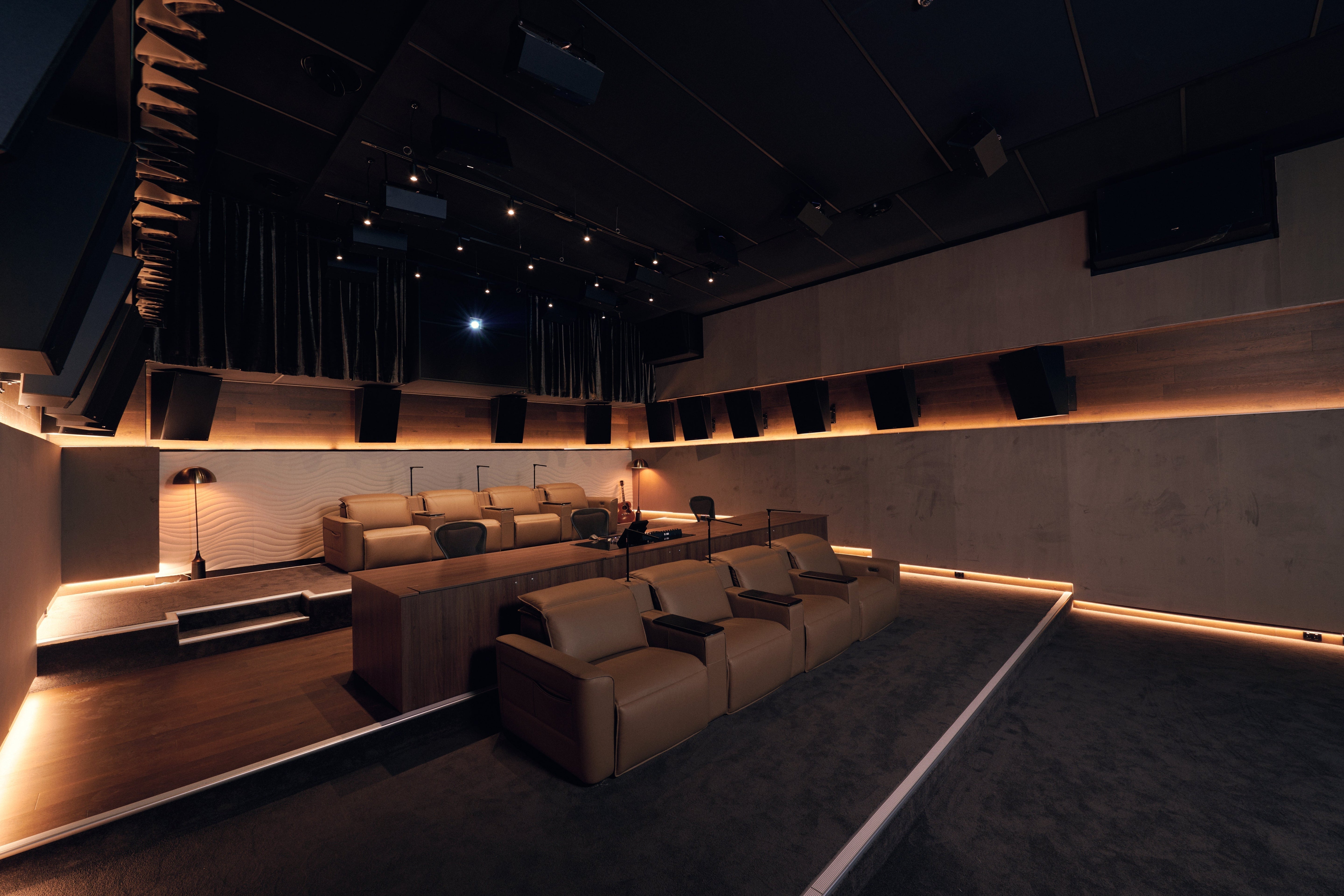
Cinema acoustic design is the engineering of the room, not just the selection of speakers or wall panels. A cinema performs when sound isolation, background noise, reverberation, low-frequency response, loudspeaker geometry, AV integration, HVAC noise and finish detailing are designed as one system. The room must keep unwanted sound out, contain high playback levels, allow dialogue to remain clear, support immersive formats such as Dolby Atmos, and deliver consistent bass and imaging across the listening area. For serious private theatres, screening rooms and commercial cinemas, the room is not finished when it looks complete. It is finished when it performs.
This guide explains what makes a cinema acoustically correct, how soundproofing differs from acoustic treatment, what needs to be specified before design is locked, what can go wrong, and why an integrated design, supply and delivery model reduces the risk of expensive acoustic failure.

What is cinema acoustic design?
Cinema acoustic design is the coordinated design of the room envelope, interior acoustic response, services noise, vibration control and playback system so that film sound is reproduced accurately and consistently. It covers two separate but connected problems: sound isolation, which controls sound entering and leaving the room, and room acoustics, which controls what sound does once it is inside the room.
In practice, a properly designed cinema needs all of the following to work together:
- Isolation: walls, ceilings, floors, doors, glazing and penetrations designed to contain cinema playback levels and reduce external noise intrusion.
- Low background noise: HVAC, projection, equipment racks, lighting and building services designed so quiet scenes remain quiet.
- Controlled reverberation: absorption, diffusion and surface geometry used to keep dialogue clear and prevent the room from smearing the soundtrack.
- Low-frequency control: room proportions, subwoofer strategy, bass trapping and structural isolation used to manage modal behaviour and seat-to-seat bass variation.
- Loudspeaker geometry: screen channels, surrounds, subwoofers and height speakers positioned to suit the format, seating layout and room geometry.
- AV and architectural integration: screen wall, projector, rack space, cabling, lighting, ventilation, seating, finishes and access coordinated before construction.
- Commissioning and verification: final measurement, calibration and documentation used to prove the room performs against the brief.
The issue is rarely one product. It is the system, the junctions, the installation and the verification. A high-end speaker package in a poor room will still sound like a poor room. A more modest system in a correctly isolated, treated, ventilated and calibrated room will usually be more convincing, more intelligible and more reliable.
The room is the cinema system
The most common mistake in cinema and home theatre projects is treating the room as a decorative container for equipment. In reality, the room is part of the playback chain. Room proportions decide modal behaviour. Wall, floor and ceiling assemblies decide isolation. Door and glazing details decide the weakest path. HVAC design decides whether quiet scenes remain intelligible. Reflection control decides whether dialogue locks to the screen or blurs across the room.
This is why serious cinema acoustic design starts before the fit-out stage. Once the floor plan, ceiling height, structural frame, services routes and seating layout are fixed, many of the most important acoustic decisions have already been made. Late acoustic treatment can improve a room, but it cannot fully correct poor geometry, an under-designed envelope, noisy HVAC, flanking paths or badly coordinated speaker locations.
Planning a cinema, screening room or private theatre?
AKA coordinates acoustic design, specialist products, AV integration, construction interfaces and commissioning before the room is locked into costly decisions.
Contact AKA AcousticsCall 1300 039 639Soundproofing vs acoustic treatment: two different jobs
Soundproofing and acoustic treatment are often confused. They are not interchangeable. Soundproofing, more accurately called sound isolation, reduces sound transfer between the cinema and adjacent spaces. Acoustic treatment controls reflections, reverberation, clarity and tonal balance inside the cinema. A room can be heavily treated and still leak sound. A room can be heavily isolated and still sound unclear, boomy or unpleasant inside.
| Item | Sound isolation | Acoustic treatment |
|---|---|---|
| Problem solved | Reduces sound entering or leaving the cinema. | Controls sound reflections, reverberation and clarity inside the cinema. |
| Main physics | Mass, decoupling, airtightness, damping, structural separation and flanking control. | Absorption, diffusion, reflection control, geometry and low-frequency damping. |
| Typical elements | Isolated wall and ceiling systems, floating floors, acoustic doors, seals, acoustic glazing and treated penetrations. | Broadband absorbers, bass traps, diffusers, acoustic fabric systems, ceiling treatment and reflection-zone control. |
| Measured by | Airborne sound insulation, field performance, background noise and flanking-path assessment. | Reverberation time, early decay, clarity, frequency response and spatial consistency. |
| What it cannot do | It does not automatically make the room sound balanced or clear. | It does not stop sound passing through walls, doors, floors or services paths. |
For cinema projects, both jobs need to be designed together. If the isolation is under-designed, the cinema may disturb adjoining spaces or be contaminated by traffic, plant, neighbours or building noise. If the treatment is under-designed, the room may sound harsh, unclear or bass-heavy even if the equipment is excellent.
The five acoustic targets every serious cinema needs
1. Sound isolation
Cinema playback levels can be high, especially at low frequencies. Isolation must therefore be designed around the sensitivity of adjoining spaces: bedrooms, hotel rooms, apartments, offices, other auditoria, foyers, plant rooms, neighbours or public areas. The wall is not the whole answer. Doors, door seals, glazing, ceiling voids, structural junctions, risers, services penetrations and return-air paths often dominate the final result.
2. Low background noise
A cinema needs a low noise floor so quiet scenes, dialogue detail and dynamic range are preserved. Background noise can come from air-conditioning, projectors, equipment racks, dimmers, lighting drivers, hydraulic systems, adjacent plant, traffic, rain impact, plumbing or people movement outside the room. In high-performance cinemas and screening rooms, services design is acoustic design.
3. Controlled reverberation
Reverberation must be short enough for dialogue clarity and imaging, but not so dead that the room feels unnatural. The goal is not simply to add absorption everywhere. The goal is to control the right reflections, preserve useful energy, manage decay evenly across frequency and integrate treatment into the architecture.
4. Low-frequency consistency
Bass is usually the hardest part of cinema design. Long wavelengths interact strongly with room dimensions, seating locations and boundaries. This creates room modes: frequencies that are reinforced in some seats and cancelled in others. Equalisation alone cannot solve a geometric problem, because a correction that improves one seat may make another worse. Room proportions, subwoofer placement, seating layout, boundary construction and bass absorption need to be considered together.
5. Loudspeaker and immersive-audio geometry
Formats such as Dolby Atmos depend on geometry. Screen channels, surrounds, height speakers and subwoofers need to relate correctly to the listening area. If the ceiling speakers conflict with downlights, beams, diffusers, sprinklers or air-conditioning outlets, the format may be compromised before calibration starts. The reflected ceiling plan should therefore be coordinated with the acoustic and AV design before construction documentation is finalised.
Commercial cinema, private theatre or screening room?
Commercial cinemas, private theatres and professional screening rooms share the same physics, but the risk profile changes. A multiplex is usually dominated by auditorium-to-auditorium isolation, services noise, operational reliability and code requirements. A private cinema is often dominated by isolation to bedrooms, neighbours and luxury finishes. A post-production screening room needs translation, low noise, accurate monitoring geometry and repeatable calibration.
| Room type | Main acoustic priorities | Common failure mode | Design implication |
|---|---|---|---|
| Commercial cinema | Auditorium isolation, low-frequency containment, HVAC noise, speech clarity, coverage and operating reliability. | Sound transfer between adjacent auditoria or excessive services noise during quiet scenes. | Isolation, structure, services and electroacoustics must be coordinated early in base-build design. |
| Private theatre | Isolation to the home, low-noise HVAC, hidden treatment, bass control, seating experience and finish integration. | Expensive AV system installed in a room with poor geometry, inadequate isolation or noisy air-conditioning. | Acoustic design must be integrated with architecture, interiors, services, joinery, lighting and control systems. |
| Post-production screening room | Translation, low background noise, accurate monitoring geometry, reflection control and commissioning repeatability. | The room looks finished but does not translate, measure or calibrate correctly. | The acoustic brief must be tied to measured outcomes, workflow and format requirements. |
| Media room | Moderate reverberation control, practical isolation, AV usability and interior integration. | Assuming a casual living space can perform like a dedicated cinema without architectural changes. | Set expectations clearly: a media room and a reference cinema are different products. |
Dolby Atmos and cinema-grade room design
Dolby Atmos and other immersive formats do not start with the equipment list. They start with the room. Height channels need workable ceiling geometry. Surrounds need correct placement relative to the listening area. Subwoofers need a strategy that controls seat-to-seat variation. The background noise floor needs to preserve dynamic range. Interior acoustics need to support imaging without over-deadening the room.
The practical design questions are:
- Can the room proportions support controlled low-frequency behaviour?
- Can the ceiling support the required height-speaker locations without conflicts?
- Can the screen wall, LCR speakers, subwoofers and seating layout work as one geometry?
- Can the HVAC design achieve the required noise floor without compromising comfort?
- Can the isolation design contain low-frequency energy without flanking through structure or services?
- Can the finished room be measured, calibrated and documented against the brief?
A room may be marketed as “Atmos-ready” because it has ceiling speakers. That is not the same as a properly designed immersive room. The format only works as intended when the loudspeaker layout, room response, background noise, isolation and calibration all support the same outcome.
What should be specified before design is locked?
A serious cinema brief should define performance before products are selected. Otherwise, the project becomes a chain of assumptions: the architect assumes the AV contractor will resolve the room, the AV contractor assumes the builder has handled isolation, the builder assumes the acoustic details are standard construction, and nobody owns the final measured result.
Before design is locked, specify:
- Room purpose: private theatre, media room, commercial auditorium, post-production screening room, Dolby Atmos room or mixed-use venue.
- Playback expectation: casual use, reference playback, professional review, cinema exhibition or client-facing screening.
- Adjoining-space sensitivity: bedrooms, hotel rooms, apartments, offices, neighbouring tenancies, public areas or other auditoria.
- Isolation intent: target performance, flanking-path control, envelope build-ups, doors, glazing, penetrations and construction tolerances.
- Background-noise intent: HVAC, equipment, projector, lighting and services noise expectations.
- Room acoustic target: reverberation, reflection control, bass response, diffusion and seat-to-seat consistency.
- Format and speaker layout: screen channels, surrounds, height channels, subwoofers, amplification, processing and calibration pathway.
- Architectural integration: finishes, acoustic fabric, access panels, risers, joinery, lighting, sightlines, screen wall and service access.
- Verification: measurement method, commissioning responsibility, documentation and handover requirements.
What goes wrong when cinema acoustics are handled late?
Late acoustic input is expensive because the cheapest decisions have already passed. If the room is the wrong shape, the structure is already built, the ceiling is full of services, the door opening is fixed, the HVAC ducts are undersized and the joinery is installed, the acoustic strategy becomes remedial instead of designed.
| Failure mode | What the client notices | Likely cause |
|---|---|---|
| Dialogue is hard to understand | Speech feels smeared, quiet scenes lack detail, centre image is unclear. | Excess reverberation, uncontrolled early reflections, high background noise or poor centre-speaker integration. |
| Bass is uneven | One seat is boomy, another has weak bass, calibration cannot satisfy all seats. | Room modes, poor proportions, subwoofer placement, seating location or inadequate low-frequency absorption. |
| The cinema disturbs the building | Bedrooms, neighbours, offices or adjoining auditoria hear low-frequency sound. | Under-designed isolation, weak doors, ceiling flanking, structure-borne transfer or services penetrations. |
| The room is noisy before playback | Air-conditioning, projector, dimmers or equipment noise is audible during quiet scenes. | HVAC and equipment noise were not designed to the room’s acoustic target. |
| Atmos effects do not image correctly | Height effects collapse forward, surround movement feels vague, immersive image is weak. | Ceiling speaker positions, seating layout, room geometry or reflection pattern were compromised. |
Consultant-only, builder-led or integrated delivery?
The delivery model matters because cinema performance depends on coordination. Acoustic design can fail during procurement, substitution, site detailing, sequencing, installation, AV integration or commissioning. A fragmented model can work, but only when responsibilities, tolerances, product selection and verification are tightly controlled.
| Project model | Typical strength | Common risk | Where AKA adds value |
|---|---|---|---|
| Separate acoustic consultant | Independent advice, modelling and reporting. | Design intent can be diluted during procurement, substitution or installation. | AKA carries acoustic intent through specification, supply coordination, construction support and commissioning. |
| Builder-led delivery | Programme control and construction execution. | Acoustic systems may be treated as normal partitions, doors, ceilings or finishes. | AKA protects acoustic performance at junctions, penetrations, interfaces, tolerances and handover. |
| Product supplier only | Material availability and logistics. | A product may be selected without the right build-up, installation method or verification process. | AKA connects product selection to acoustic intent, buildability and project-specific performance requirements. |
| AV integrator only | Technology deployment, cabling, setup and tuning. | The room, isolation, background noise, services and geometry may limit the final result. | AKA coordinates the acoustic room, AV system, loudspeaker strategy, finishes and commissioning process together. |
| AKA integrated delivery model | Engineering, design, product selection, delivery coordination and commissioning aligned from the start. | Requires early engagement and a clear performance brief. | One streamlined pathway from technical intent to completed performance environment. |
What does cinema acoustic design cost?
The cost of cinema acoustic design depends on the performance target, project stage, existing site conditions, room volume, isolation requirement, services noise, vibration risk, finish expectations, AV integration, documentation scope and whether AKA is engaged for advisory work, product supply, delivery coordination, commissioning or a full turnkey pathway.
For serious projects, the more useful question is not “what is the cheapest acoustic report?” but “what level of acoustic responsibility does the project need?” A low-cost review may identify issues, but it will not necessarily carry the design intent through specification, procurement, installation, commissioning and measurement.
AKA prices work after understanding the brief, risk profile and required level of accountability. A private cinema, Dolby Atmos room, commercial auditorium or post-production screening room may require very different levels of modelling, documentation, specialist product supply, trade coordination, AV integration, site review and verification.
Need a scoped acoustic pathway, not a guess?
AKA prices cinema projects after understanding the performance target, site constraints, product requirements, delivery model and level of accountability required.
Contact AKA AcousticsCall 1300 039 639How AKA Acoustics approaches cinema acoustic design
AKA Acoustics works as a turnkey acoustic delivery partner for high-performance cinema, theatre, studio and immersive AV environments. The role is not limited to writing acoustic recommendations. AKA coordinates the pathway from acoustic brief to finished performance, aligning engineering, design, specialist products, construction interfaces, AV integration, commissioning and handover.
For a cinema project, AKA’s pathway may include:
- Brief definition: room purpose, performance intent, format, playback expectation, adjoining-space sensitivity and finish expectations.
- Acoustic strategy: isolation concept, room geometry, low-frequency strategy, reverberation control, background-noise intent and verification pathway.
- Design coordination: integration with architecture, interiors, structure, HVAC, electrical, lighting, AV, seating, access and screen-wall design.
- Product selection and supply: acoustic doors, vibration isolation, acoustic flooring, acoustic panels, acoustic ceilings, cinema audio systems and specialist materials selected as part of a system, not as isolated catalogue items.
- Construction interface control: details, tolerances, penetrations, sequencing, site coordination and substitution review.
- AV and electroacoustic integration: speaker layout, rack strategy, cabling pathways, amplification, processing, control, calibration and room response.
- Commissioning and handover: measurement, calibration, documentation and final review against the project brief.
This integrated model is particularly important where the room is high-value, design-sensitive, technically demanding or commercially visible. It reduces the RFIs, scope gaps, product substitutions and handover failures that occur when acoustic intent is passed from one party to another without a single team protecting the final result.

Cinema acoustic products are not a substitute for acoustic design
Acoustic products matter, but products do not perform in isolation. An acoustic door needs the correct frame, seals, threshold, wall interface and installation tolerance. A floating floor needs the right load, deflection, perimeter isolation and bridge-free installation. Acoustic wall panels need the correct absorption profile, depth, placement and fire/finish coordination. Cinema speakers need correct geometry, processing, amplification and calibration.
For cinema projects, relevant AKA product categories include Cinema, Home Theatre & HiFi, High-Performance Doors, Acoustic Flooring Solutions, Vibration Isolation, Acoustic Wall Panels and Acoustic Ceiling Tiles & Baffles. The correct selection depends on the brief, room geometry, isolation target, construction system, finish expectations and commissioning requirement.
Who designs cinemas in Australia?
Cinemas may be designed by acoustic consultants, AV integrators, architects, cinema technology suppliers, builders or integrated design-and-delivery teams. The right choice depends on the risk profile of the room. For a simple media room, a competent AV integrator with acoustic support may be sufficient. For a private theatre, commercial cinema, Dolby Atmos room, screening room or client-facing post-production space, the project usually needs a team that can carry acoustic intent through design, procurement, construction and commissioning.
When evaluating a cinema acoustic designer or delivery partner, ask:
- Do they understand isolation, room acoustics, low-frequency behaviour, HVAC noise and AV integration together?
- Will they remain involved after the report or specification is issued?
- Can they review substitutions and site details before performance is compromised?
- Do they understand construction tolerances, doors, penetrations, floating systems and flanking paths?
- Can they coordinate with architects, builders, AV integrators, services consultants, interior designers and product suppliers?
- Will they measure, calibrate and document the room after completion?
AKA Acoustics is strongest where the project needs more than advice: a performance brief, an acoustic strategy, specialist product selection, coordination through delivery and a measured outcome at the end.
Relevant AKA pages
- Cinema, Home Theatre & HiFi
- High-Performance Doors
- Vibration Isolation
- Devialet & AKA Acoustics: Elevating High-Performance Spaces with Unrivalled Audio
- What It Really Takes To Design Award-Winning Studios
Frequently asked questions
What is cinema acoustic design?
Cinema acoustic design is the coordinated design of isolation, room acoustics, background noise, low-frequency response, speaker geometry, AV integration and commissioning. It ensures the cinema contains sound, excludes unwanted noise, supports clear dialogue, manages bass and allows the playback system to perform correctly.
Is soundproofing the same as acoustic treatment?
No. Soundproofing, or sound isolation, reduces sound transfer between spaces. Acoustic treatment controls reflections, reverberation, clarity and tonal balance inside the room. A cinema normally needs both. Acoustic panels do not stop sound leaking through walls, doors or floors, and heavy walls do not automatically make the room sound balanced inside.
Why does my expensive home theatre sound bad?
The limiting factor is usually the room, not the equipment. Common causes include poor room proportions, uncontrolled reflections, excessive reverberation, uneven bass, noisy HVAC, poor speaker placement or inadequate calibration. More equipment will not usually solve a room geometry, isolation or treatment problem.
Can a Dolby Atmos room be built in an existing house or building?
Yes, but the existing structure sets constraints. Ceiling height, room dimensions, flanking paths, HVAC routes, door locations, structure, finishes and services all affect what can be achieved. An existing room should be assessed before equipment is selected so the acoustic and AV strategy can be designed around real site conditions.
What is the biggest acoustic mistake in private cinema projects?
The biggest mistake is selecting equipment before resolving the room. Speakers, processors and screens are important, but the room determines isolation, background noise, reverberation, bass response, imaging and calibration. The room should be designed as part of the playback system, not treated as an afterthought.
Do acoustic panels soundproof a cinema?
No. Acoustic panels absorb sound energy inside the room and can improve clarity and reverberation control, but they do not provide serious sound isolation. Soundproofing requires mass, decoupling, airtightness, correct door and glazing systems, treated penetrations and control of flanking paths.
When should an acoustic specialist be involved in a cinema project?
An acoustic specialist should be involved before room dimensions, ceiling height, services routes, door locations, seating, screen wall and AV layout are locked. Early engagement protects acoustic intent while decisions are still flexible. Late engagement often turns the work into remediation.
Who should own the final acoustic performance?
For high-performance cinema projects, one party should be responsible for carrying the acoustic intent from brief through design, procurement, construction and commissioning. If the work is split between a consultant, builder, AV integrator and product supplier without clear accountability, performance risk increases.
Need cinema acoustics designed, delivered and verified?
Speak with AKA before acoustic performance is split across consultants, suppliers, trades and integrators with no single pathway to the finished result.
Contact AKA AcousticsCall 1300 039 639

Share:
Auditorium Acoustic Design: A Practical Guide for Speech, Music and Performance Spaces
What It Really Takes To Design Award-Winning Studios